Choosing an inverter is no longer a simple wattage calculation. The right decision affects backup performance, battery charging, grid interaction, and future expansion. The International Energy Agency’s Renewables 2024 report states that global renewable capacity additions reached almost 510 gigawatts in 2023, with solar PV contributing about three-quarters of that growth. As rooftop solar expands, hybrid inverters are becoming central to household energy management.
So, how to choose between single phase and three phase hybrid inverter depends on more than panel capacity. It requires a close look at your electrical supply, peak loads, battery plans, and local grid requirements. A single-phase model may suit a compact home with balanced daily demand, limited backup circuits, and a smaller battery. A three-phase model can distribute power across heavier loads, such as heat pumps, workshops, elevators, or large irrigation systems. Check the meter first.
Jürgen Reinert, former CEO of SMA Solar Technology, described the inverter as “the heart of every photovoltaic system.” That comparison remains practical. An inverter decides how solar generation, battery storage, household consumption, and grid power interact. However, no universal answer exists. A larger system is not automatically better. Installation cost, phase imbalance, export limits, and service availability can change the outcome. IEA and NREL guidance both emphasize system-level planning rather than isolated equipment selection. This article examines those trade-offs with real operating details, while acknowledging one uncomfortable truth: even a technically correct choice can perform poorly when the home’s actual load profile is misunderstood.
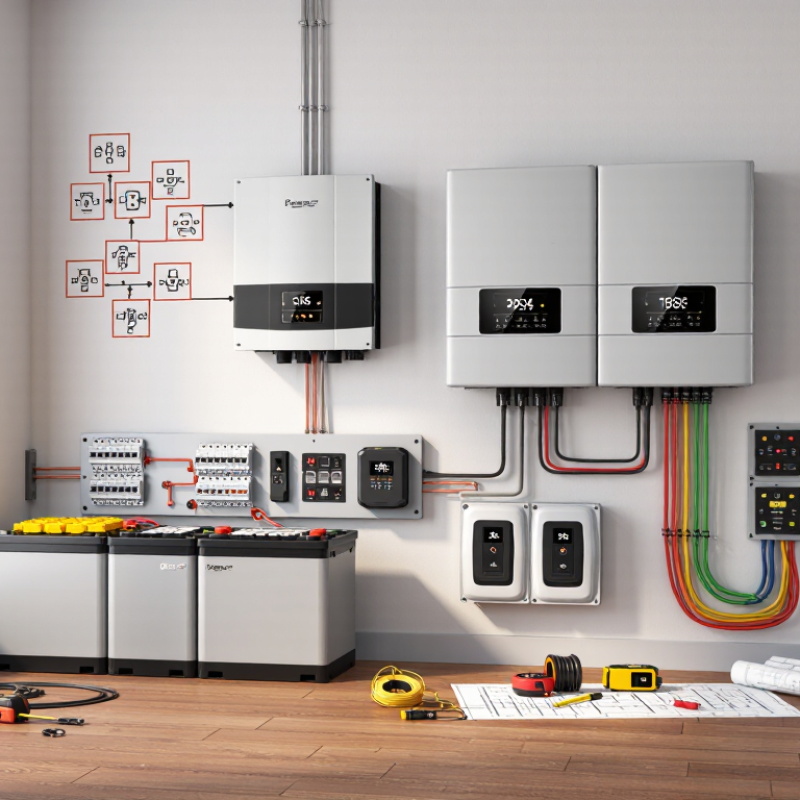
Under IEC 60038, a typical low-voltage network uses 230 V between line and neutral, and 400 V between phases. Measure this at the site, not from a brochure. A 230 V single-phase inverter connects to one phase. A three-phase inverter distributes power across L1, L2, and L3. The choice depends on phase demand, not only total household consumption. A 9 kW load may look large, but its real demand could remain below 3 kW per phase.
Review the site’s largest simultaneous loads: heat pumps, induction cookers, pumps, and electric vehicle chargers. Check their starting currents too. The IEA Electricity 2024 report expects global electricity demand to grow by more than 4% in 2024, reflecting wider electrification. That trend makes phase planning less forgiving.
A balanced three-phase system can reduce conductor stress and improve load distribution. However, a single-phase system may suit a compact dwelling with modest, concentrated loads.
Field experience shows an awkward truth. Appliance ratings rarely match real operating patterns. A neat spreadsheet can still lie. Record phase currents with a suitable power-quality meter during cooking, heating, and charging. Then compare the results with the inverter’s continuous output, surge capability, neutral arrangement, and local connection limits.
IEA PVPS Trends 2024 reported record global photovoltaic deployment in 2023, increasing pressure on distribution networks. Verify export rules and phase-unbalance limits with the network operator before selecting equipment.
Above 10 kW, phase selection becomes an electrical design decision, not a simple inverter upgrade. The IEA’s Renewables 2024 report records about 510 GW of new renewable capacity worldwide in 2023, with solar providing roughly three quarters. More systems now serve larger homes, workshops, farms, and small commercial buildings. Their loads are rarely perfectly balanced.
At 10 kW, a 230-volt single-phase supply draws about 43.5 amps. A balanced 400-volt three-phase supply draws only about 14.4 amps per phase. That difference can reduce cable heating, voltage drop, and main-switch stress.
It can also support pumps, compressors, induction equipment, and other three-phase motors more naturally. A single-phase hybrid inverter may still suit a site with stable household loads, short cable runs, and utility approval for higher current.
I would inspect the measured load profile before choosing. NREL’s 2024 photovoltaic and storage cost benchmarks separate residential and commercial system designs, showing why site scale changes equipment assumptions. Check peak demand, phase imbalance, backup circuits, battery charging power, and future loads. A three-phase inverter does not automatically solve an unbalanced building. Some units limit backup output on one phase. Some cannot start heavy motors reliably. The neat answer is often three-phase above 10 kW, but that rule is incomplete. Meter records and a qualified electrical assessment matter more than a convenient threshold.
How to Choose a Single Phase or Three Phase Hybrid Inverter
Size PV Arrays and Batteries Using 95%+ Inverter Efficiency Targets
A hybrid inverter should match both household demand and the planned solar array. Single-phase systems often suit smaller homes with balanced daily loads. Three-phase systems distribute power more evenly across larger properties. Check the service connection before choosing either design. Local electrical requirements still matter.
Use the inverter’s real operating efficiency, not only its headline rating. A 95% efficient unit loses about 500 watts from every 10 kilowatts transferred. Include cable losses, temperature derating, standby consumption, and battery conversion losses. A practical PV design may need extra capacity to cover these losses. Avoid oversizing without checking the inverter’s maximum input current.
Battery sizing requires measured usage. Start with overnight energy demand, then add a reserve for cloudy periods. For example, a home using 12 kilowatt-hours overnight may need more than a 12-kilowatt-hour battery. Usable capacity depends on the permitted depth of discharge and efficiency. Keep emergency loads separate from flexible loads.
Peak demand can expose a weak design quickly. Pumps, ovens, and compressors may start together. I have seen storage plans fail because average consumption looked harmless. That mistake is easy to repeat. A three-phase inverter may improve load sharing, but it will not fix poor wiring or inaccurate measurements. Review one week of interval data before final sizing. Efficiency targets are useful, but real conditions can be less tidy.
Choosing a single-phase or three-phase hybrid inverter starts with the service connection. However, grid interconnection rules should guide the decision. IEEE 1547 applies mainly to distributed energy resources connected to North American grids. EN 50549 covers similar connections across many European networks. Both address voltage, frequency, anti-islanding, reconnection, and abnormal grid behavior.
Check the inverter’s certification, test reports, and configurable grid settings before comparing power ratings. A single-phase unit may suit a small home with a matching service panel. A three-phase unit is often more suitable for balanced commercial loads or three-phase utility service. The wrong choice can create phase imbalance, nuisance trips, or rejected interconnection paperwork. It happens more often than expected.
Ask the utility which edition and national settings apply. Requirements may include reactive power control, frequency-watt response, ride-through limits, export control, and communication functions. Confirm these settings can be locked or documented during commissioning. A label mentioning IEEE 1547 or EN 50549 is not enough. The exact test scope matters. Local rules can be stricter. One overlooked setting can delay approval. In practice, installers should compare the service diagram, protection study, and inverter certificate before installation. I would also recheck the final settings after firmware changes, because a compliant design can become uncertain when assumptions are left undocumented.
| Selection and Compliance Dimension | Single-Phase Hybrid Inverter | Three-Phase Hybrid Inverter | Verification Considerations |
|---|---|---|---|
| Typical electrical connection | One alternating-current phase and neutral, commonly 230 V line-to-neutral in many IEC-based systems. | Three alternating-current phases, commonly 400 V line-to-line and 230 V line-to-neutral in a 230/400 V system. | Confirm the service arrangement shown on the utility connection agreement and the site distribution-board diagram. |
| Recommended application | Small residential loads, apartments, cabins, or properties supplied by a single-phase service. | Large homes, commercial premises, workshops, agricultural facilities, and sites with balanced three-phase loads. | The inverter phase configuration should match the point of common coupling and the intended backup-load arrangement. |
| Power-current relationship | For approximately 10 kW at 230 V and power factor 1.0: I ≈ 43.5 A. | For approximately 10 kW at 400 V, three-phase, and power factor 1.0: I ≈ 14.4 A per phase, using I = P ÷ (√3 × V). | Three-phase distribution generally lowers current per conductor for the same total power. Cable size, protective devices, and voltage drop still require engineering verification. |
| Load balancing | Most site power is delivered through one phase, so high-power appliances can create greater current concentration. | Loads can be distributed across three phases, reducing phase loading when the installation is properly balanced. | Check local limits for phase imbalance, neutral current, and maximum power permitted on one phase. |
| Solar PV and battery sizing | Suitable when the PV array, battery, and backed-up loads remain within the single-phase current and power limits. | Suitable for higher site power, three-phase PV generation, and systems requiring coordinated power across all phases. | Confirm whether the inverter is permitted to export evenly across phases or whether phase-specific export control is required. |
| Backup operation | Usually supplies a designated single-phase backup panel. It may not energize all phases of a three-phase property. | May provide coordinated three-phase backup, subject to the inverter architecture, neutral arrangement, starting-current capability, and local approval. | Verify transfer equipment, islanding protection, neutral switching, short-circuit rating, motor-starting capability, and permitted backup topology. |
| IEEE 1547 scope relevance | IEEE 1547-2018 establishes requirements for distributed energy resources interconnected with an electric power system, including voltage and frequency performance, abnormal-condition response, power quality, islanding, interoperability, and testing provisions. | Use the applicable utility adoption, IEEE 1547.1 conformance testing, and local interconnection procedure. The standard alone does not replace utility approval or national electrical rules. | |
| IEEE 1547 voltage and frequency functions | The inverter should support the required voltage and frequency ride-through, trip, reconnection, reactive-power, and active-power functions defined by the applicable interconnection category and utility settings. | Do not select settings only from a generic datasheet. Confirm the required performance category, default values, clearing times, reconnection delay, and permitted field-adjustable ranges. | |
| EN 50549-1 relevance | EN 50549-1 applies to generating units connected in parallel with low-voltage distribution networks, generally covering low-voltage connections up to 1 kV AC. | Confirm the national implementation, distribution-system operator requirements, type-test evidence, anti-islanding behavior, voltage and frequency limits, and commissioning documentation. | |
| EN 50549-2 relevance | EN 50549-2 applies to generating units connected to medium-voltage distribution networks, generally above 1 kV AC and up to 36 kV AC. | Use EN 50549-2 only when the connection is a medium-voltage installation and the network operator requires it. The transformer and protection design may introduce additional requirements. | |
| Anti-islanding and reconnection | Must detect loss of the utility supply and cease energizing the grid as required by the applicable standard and utility procedure. | Must provide coordinated detection and reconnection behavior for all connected phases and the approved operating mode. | Verify certified test results, reconnection timing, active and passive detection methods, and the interaction with external interface protection. |
| Export limitation | May require a certified meter or current transformer arrangement to limit export at the single-phase connection point. | May require phase-by-phase measurement and control to prevent one phase from exceeding its export limit. | Confirm meter direction, CT orientation, measurement accuracy, fail-safe behavior, communication loss response, and utility witness-test requirements. |
| Reactive-power and power-factor control | Reactive-power control is applied to the single connected phase, subject to inverter capability and grid-code settings. | Reactive-power control may be coordinated across all three phases, with requirements depending on the network operator and connection capacity. | Check required power-factor range, Volt-VAr or Q(U) curves, active-power curtailment interaction, and the response to voltage changes. |
| Harmonics and power quality | Assess current distortion, flicker, DC injection, and unbalance at the single-phase point of connection. | Assess total harmonic distortion, individual harmonic currents, negative-sequence effects, flicker, and phase-current balance. | Use the inverter certificate and installation design to demonstrate compliance with the applicable IEEE, EN, national, and utility limits. |
| Protection and switching | Requires correctly rated overcurrent protection, isolation, surge protection, residual-current protection where applicable, and an approved grid interface. | Requires coordinated three-pole or four-pole switching as specified, phase overcurrent protection, surge protection, and appropriate residual-current protection. | Protection settings must be coordinated with the utility supply, inverter fault current, battery system, backup loads, and local installation regulations. |
| Neutral and earthing arrangement | Neutral treatment and protective-earthing compatibility must match the supply system and backup configuration. | Neutral continuity, neutral switching, phase sequence, protective bonding, and transformer earthing must be checked for both grid-connected and islanded operation. | Confirm the supply earthing system, inverter isolation requirements, neutral-to-earth bonding location, and requirements for a separately derived backup source. |
| Installation complexity | Generally simpler for a single-phase property, with fewer conductors and a simpler backup panel. | Typically requires more detailed phase allocation, phase-sequence checks, coordinated protection, and three-phase commissioning. | Complexity depends on the service rating, battery size, backup design, export limit, communications, and required grid-protection equipment. |
| When to choose this configuration | Choose single phase when the utility service is single phase, total power is within the approved phase limit, and the backup requirement is limited to single-phase circuits. | Choose three phase when the premises has a three-phase service, significant three-phase loads, higher total power, or a requirement to coordinate supply across all phases. | Final selection should be based on the approved connection capacity, inverter certification, local grid code, installation design, and utility acceptance—not only on nominal inverter power. |
Choosing a single-phase or three-phase hybrid inverter starts with the backup plan, not the panel count. A single-phase model suits many homes with modest loads, especially when essential circuits share one phase. Three-phase equipment is safer for larger homes, workshops, pumps, and properties with balanced three-phase appliances. During an outage, confirm whether the inverter can back up every phase. Some systems cannot.
Cost needs a wider view. The IEA Renewables 2024 report recorded about 420 GW of new solar capacity in 2023, showing how quickly distributed energy systems are expanding. More installations also mean more complex household loads. A cheaper single-phase inverter may reduce initial spending, but phase limitations can create rewiring costs later. Three-phase systems usually cost more upfront. They may reduce upgrade friction when demand rises.
Future expansion deserves careful attention. The National Renewable Energy Laboratory’s 2024 Annual Technology Baseline shows continued cost reductions for battery storage, although actual savings depend on duration, cycling, and installation conditions. Leave space for additional battery capacity, larger protection devices, and communication upgrades. Check the inverter’s maximum current, battery voltage range, and parallel-unit limits. I would not size only for today’s appliances. That assumption can be wrong. A three-phase inverter is not automatically better, either; low household demand can leave its capacity underused. Compare outage priorities, electricity tariffs, local phase requirements, and five-year load estimates before choosing.
Typical residential planning benchmarks comparing backup capability, system scale, and future expansion potential.
Single-phase systems commonly suit smaller homes and essential-load backup around 5–10 kW. Three-phase systems typically support larger homes, higher simultaneous loads, and easier expansion across multiple phases. Actual limits depend on local grid rules, inverter configuration, battery capacity, and electrical design.
Larger loads create higher current and greater wiring stress. Phase choice becomes a design decision. Measure first.
At 230 volts, a single-phase load draws about 43.5 amps. A balanced 400-volt three-phase load draws about 14.4 amps per phase.
It may suit stable household loads, short cable runs, and essential circuits on one phase. The supply must support the required current.
It often fits larger homes, workshops, pumps, compressors, and three-phase motors. These loads can operate more naturally across balanced phases.
No. An uneven building load can still overload one phase. Review meter records and circuit distribution.
Not always. Some inverters limit backup output on one phase. Confirm the backup arrangement before installation.
Its initial price may be lower. Later rewiring, protection changes, or capacity limits can increase the total cost. Cheap today can become awkward.
Check maximum current, battery voltage range, parallel-unit limits, and communication capacity. Leave space for larger protection devices and extra batteries.
Not automatically. Low demand may leave its capacity underused. Compare peak loads, tariffs, backup priorities, and five-year demand estimates. My first estimate could still be wrong.
Choosing the right hybrid inverter begins with understanding the site’s voltage and phase requirements. In IEC 60038 systems, a typical supply is 230 V for single-phase loads and 400 V between phases in a three-phase installation. Single-phase inverters may suit homes with modest demand, while three-phase systems are generally more practical when total loads exceed about 10 kW or when power must be distributed evenly across phases. PV capacity and battery storage should be matched to daily consumption, peak demand, backup objectives, and an inverter efficiency target of at least 95%.
To understand how to choose between single phase and three phase hybrid inverter options, also verify grid-interconnection requirements under IEEE 1547 and EN 50549, including voltage, frequency, protection, and anti-islanding functions. Finally, compare backup priorities, installation cost, available space, and future expansion plans. A well-sized system should support essential loads reliably today while leaving sufficient capacity for additional solar generation, batteries, electric vehicles, or other high-demand equipment in the future.

Yde Power